
One blog post. $1M+ in revenue. Zero ad spend.
Not a case study. Not a product page. A "Competitor Alternatives" post.
These are THE highest-converting articles. Most companies aren't writing them.
Why they work:
Someone Googling "Slack Alternatives" isn't browsing.
They're done with their current tool and actively hunting for a replacement.
That's a buyer with their wallet already open.
If you run a team communication platform, you'd target:
- Microsoft Teams Alternatives
- Discord Alternatives
- Slack Alternatives
That's 16,500 searches/month from people ready to switch, not just scroll.
The leverage compounds:
- Buyers are ready to purchase the moment they land on your page
- LLMs like ChatGPT and Perplexity cite well-ranking alternative posts when recommending tools
- One article drives Google traffic AND AI visibility
Our client's post is still generating revenue 3 years later.
Here's how to write your own:
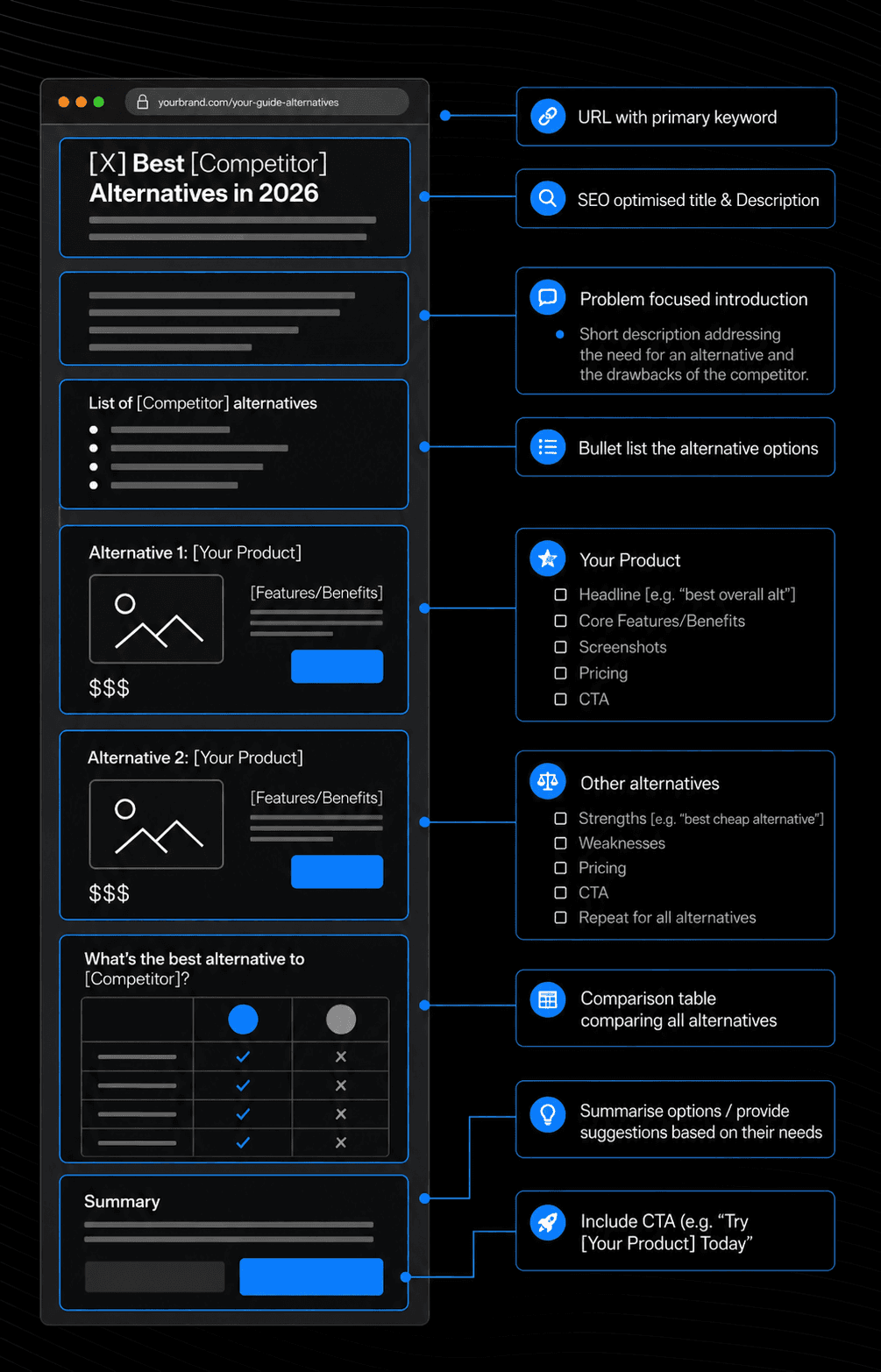
Competitor Alternatives Blog Post Framework
Use this framework to write high-intent comparison blogs such as:
Best [Competitor] Alternatives[Competitor] Alternatives for [Use Case][Competitor] vs [Your Product]Top [Category] Tools for [Audience]
The goal of this blog is not just to rank on Google.
The real goal is to help a reader compare options clearly, understand where each product fits, and choose the best tool for their needs.
1. Blog Goal
A competitor alternatives blog should do three things:
- Capture search intent from people looking for alternatives.
- Educate the reader on available options.
- Position your product as the best-fit solution for a specific audience.
This blog works best when the reader is already problem-aware.
They know the competitor. They know the category. They are now searching for a better option.
2. Inputs Required Before Writing
Before writing the blog, collect these details:
Primary Inputs
- Competitor name
- Your product name
- Product category
- Target audience
- Primary keyword
- Secondary keywords
- Main pain point with the competitor
- Your product’s strongest differentiator
- Pricing details
- Screenshots or product visuals
- CTA link
Alternative Product Inputs
For every alternative, collect:
- Product name
- Best use case
- Core features
- Strengths
- Weaknesses
- Pricing
- Ideal customer
- CTA link
3. Recommended URL Structure
The URL should include the primary keyword.
Format
/blog/[competitor]-alternatives
Examples
/blog/notion-alternatives
/blog/hubspot-alternatives
/blog/stripe-atlas-alternatives
/blog/best-ai-seo-tools
Rule
Keep the URL short, readable, and keyword-focused.
Avoid unnecessary words like:
- top
- best
- complete-guide
- ultimate-list
- 2026-guide
Use them in the title if needed, not always in the slug.
4. SEO Title and Meta Description
The title should clearly match search intent.
Title Formula
[X] Best [Competitor] Alternatives in [Year]
Example
7 Best HubSpot Alternatives in 2026
10 Best Stripe Atlas Alternatives for Global Founders
9 Best Ahrefs Alternatives for AI Search Visibility
Meta Description Formula
Looking for the best [Competitor] alternative? Compare [X] tools based on features, pricing, strengths, weaknesses, and use cases to find the right fit for [audience].
Example
Looking for the best HubSpot alternative? Compare 7 CRM tools based on features, pricing, strengths, weaknesses, and use cases to find the right platform for your team.
5. Blog Structure Overview
Use this structure:
- SEO title
- Problem-focused introduction
- Quick list of alternatives
- Your product as Alternative #1
- Other alternatives
- Comparison table
- Recommendations based on needs
- Summary
- CTA
Full Blog Template
## H1: [X] Best [Competitor] Alternatives in [Year]

Start with a direct title that includes the competitor, the word “alternatives,” and the year.

### Example

`7 Best [Competitor] Alternatives in 2026`

---

## Introduction

The introduction should be problem-focused.

Do not start by praising the competitor too much.

Instead, explain why someone may be looking for an alternative.

### Introduction Formula

`[Competitor] is a popular tool for [use case], but it may not be the right fit for everyone.`

`Some teams look for alternatives because of [pain point 1], [pain point 2], or [pain point 3].`

`In this guide, we’ll compare the best [Competitor] alternatives based on features, pricing, strengths, weaknesses, and ideal use cases.`

### Example

`[Competitor] is a popular tool for [category], but it may not be the right fit for every team.`

`Some users look for alternatives because of pricing, limited flexibility, missing features, or a product experience that no longer matches their workflow.`

`In this guide, we’ll compare the best [Competitor] alternatives so you can choose the right tool based on your needs, budget, and use case.`

---

## Quick List of Alternatives

Add a short bullet list near the top.

This helps the reader quickly understand what tools will be covered.

### Format

* [Your Product] — Best overall alternative for [specific audience]
* [Alternative 2] — Best for [use case]
* [Alternative 3] — Best for [use case]
* [Alternative 4] — Best for [use case]
* [Alternative 5] — Best for [use case]

### Example

* [Your Product] — Best overall alternative for growing teams
* [Alternative 2] — Best for small businesses
* [Alternative 3] — Best for enterprise teams
* [Alternative 4] — Best for budget-conscious users
* [Alternative 5] — Best for advanced customization

---

# Alternative #1: [Your Product]

Place your product first.

This section should be the strongest part of the blog.

Do not make it sound like an ad.

Make it sound like a clear, useful recommendation.

---

## Best For

`Best for [specific audience] who need [specific outcome].`

### Example

`Best for remote founders who need incorporation, banking, payments, and compliance in one platform.`

---

## Why [Your Product] Is a Strong Alternative to [Competitor]

Explain the positioning clearly.

### Formula

`[Your Product] is a strong alternative to [Competitor] because it helps [audience] solve [specific problem] without [main friction].`

### Example

`[Your Product] is a strong alternative to [Competitor] because it helps remote founders manage business infrastructure without stitching together multiple tools for incorporation, banking, payments, and compliance.`

---

## Core Features

List 4 to 6 core features.

### Format

* Feature 1 — Short benefit
* Feature 2 — Short benefit
* Feature 3 — Short benefit
* Feature 4 — Short benefit

### Example

* Incorporation support — Set up your business entity faster
* Banking access — Manage business banking from one place
* Onchain payments — Get paid globally
* Compliance tools — Stay aligned with local requirements
* Founder dashboard — Manage everything from one workflow

---

## Strengths

Mention where your product is clearly better.

### Format

* Strong for [audience]
* Easier to use for [workflow]
* Better suited for [specific use case]
* More focused on [problem]
* Helps reduce [pain point]

---

## Weaknesses

Be honest.

This builds trust.

### Format

* Not ideal for [audience]
* May not support [advanced use case]
* Still expanding in [region/category]
* Better suited for [specific customer type]

---

## Pricing

Keep this simple.

### Format

`Pricing: [Free / Starts at $X / Custom pricing / Contact sales]`

If pricing is not public, write:

`Pricing is available on request.`

---

## CTA

Add a clear CTA.

### Examples

`Try [Your Product] today.`

`Book a demo with [Your Product].`

`Explore how [Your Product] can help your team.`

---

# Alternative #2: [Alternative Product]

Use the same structure for each alternative, but keep it shorter than your product section.

## Best For

`Best for [specific use case].`

## Overview

`[Alternative Product] is a [category] tool built for [audience]. It helps users [main outcome].`

## Strengths

* Strength 1
* Strength 2
* Strength 3

## Weaknesses

* Weakness 1
* Weakness 2
* Weakness 3

## Pricing

`Pricing: [Pricing details]`

## CTA

`Visit [Alternative Product]`

---

# Alternative #3: [Alternative Product]

Repeat the same format.

## Best For

`Best for [specific use case].`

## Overview

`[Alternative Product] is a [category] tool built for [audience]. It helps users [main outcome].`

## Strengths

* Strength 1
* Strength 2
* Strength 3

## Weaknesses

* Weakness 1
* Weakness 2
* Weakness 3

## Pricing

`Pricing: [Pricing details]`

## CTA

`Visit [Alternative Product]`

---

# Comparison Table

After listing all alternatives, add a comparison table.

This helps the reader make a faster decision.

## Table Format

| Product         | Best For   | Key Strength | Weakness   | Pricing   |
| --------------- | ---------- | ------------ | ---------- | --------- |
| [Your Product]  | [Audience] | [Strength]   | [Weakness] | [Pricing] |
| [Alternative 2] | [Audience] | [Strength]   | [Weakness] | [Pricing] |
| [Alternative 3] | [Audience] | [Strength]   | [Weakness] | [Pricing] |
| [Alternative 4] | [Audience] | [Strength]   | [Weakness] | [Pricing] |

---

# Recommendation Section

This section helps the reader choose based on their specific need.

## Format

Choose [Your Product] if you want [outcome].

Choose [Alternative 2] if you need [use case].

Choose [Alternative 3] if your priority is [use case].

Choose [Alternative 4] if you are looking for [use case].

### Example

`Choose [Your Product] if you want an all-in-one platform built specifically for remote founders earning onchain.`

`Choose [Alternative 2] if you need a simple entry-level tool for smaller teams.`

`Choose [Alternative 3] if your team needs advanced enterprise features.`

---

# Summary

The summary should restate the key decision clearly.

### Summary Formula

`The best [Competitor] alternative depends on your team’s needs.`

`If you need [use case], [Alternative] may be a good fit.`

`If you need [your product’s strongest value proposition], [Your Product] is the strongest option to consider.`

### Example

`The best [Competitor] alternative depends on what your team needs most.`

`Some tools are better for affordability. Others are better for enterprise workflows or advanced customization.`

`But if you are looking for a focused solution built for [audience], [Your Product] is the strongest option to consider.`

---

# Final CTA

End with one clear action.

### CTA Examples

`Ready to try [Your Product]? Get started today.`

`Want to see how [Your Product] compares? Book a demo.`

`Explore [Your Product] and see how it can help your team [achieve outcome].`

---
Writing Checklist
Before publishing, check these points:
- The primary keyword is in the URL.
- The title includes “[Competitor] alternatives.”
- The introduction explains why people search for alternatives.
- Your product is positioned as Alternative #1.
- Every alternative has strengths, weaknesses, pricing, and best use case.
- The comparison table is easy to scan.
- The recommendation section helps different types of readers.
- The CTA is clear.
- The article is useful even if the reader does not choose your product.
- The tone is educational, not overly promotional.
Quality Rules
Follow these rules while writing:
1. Be Honest
Do not make every competitor look bad.
A good alternatives blog should feel fair.
If the reader senses bias, they will stop trusting the article.
2. Be Specific
Avoid vague claims like:
- Best platform
- Most powerful
- Game-changing
- Revolutionary
Use specific claims instead:
- Best for remote founders
- Best for small teams
- Best for enterprise compliance
- Best for affordable pricing
- Best for advanced analytics
3. Use Clear Comparison Language
Use phrases like:
- “Best for…”
- “Not ideal for…”
- “Compared to [Competitor]…”
- “A better fit if…”
- “Choose this if…”
4. Make Your Product the Best Fit, Not the Only Fit
Do not say your product is best for everyone.
Say it is best for a specific audience with a specific problem.
That sounds more believable.
5. Add Real Screenshots
If possible, include screenshots for your product.
Screenshots make the article feel more trustworthy and less generic.
6. Keep Paragraphs Short
Use short paragraphs.
One idea per paragraph.
This improves readability and makes the blog easier to scan.
Reusable Prompt for Writing This Blog
Use this prompt whenever you want to generate a competitor alternatives blog:
Write a detailed SEO blog titled “[X] Best [Competitor] Alternatives in [Year]”.
The primary keyword is “[keyword]”.
The target audience is “[audience]”.
Our product is “[Your Product]”, and it should be positioned as the best option for “[specific use case]”.
Include a problem-focused introduction, a quick list of alternatives, a detailed section for our product, shorter sections for other alternatives, a comparison table, recommendation section, summary, and final CTA.
For each alternative, include best use case, overview, strengths, weaknesses, pricing, and CTA.
Make the tone helpful, honest, clear, and comparison-focused. Do not sound overly promotional.
More Posts
7 high-performing Twitter/X hook templates tailored for company accounts
No description available
Bad Copywriting vs Good Copywriting
This article will help you understand the difference between bad copywriting and good copywriting, and how to improve your copywriting skills.
Copywriting
This article will help you understand the importance of copywriting and how to write effective copy.
Top Resources to Follow for Creative Founders
A curated list of blogs, newsletters, and communities that provide valuable insights and support for solo founders.
Want more practical SaaS breakdowns?
Browse all posts and keep shipping momentum.